VISUAL INSPECTION SUMMARY
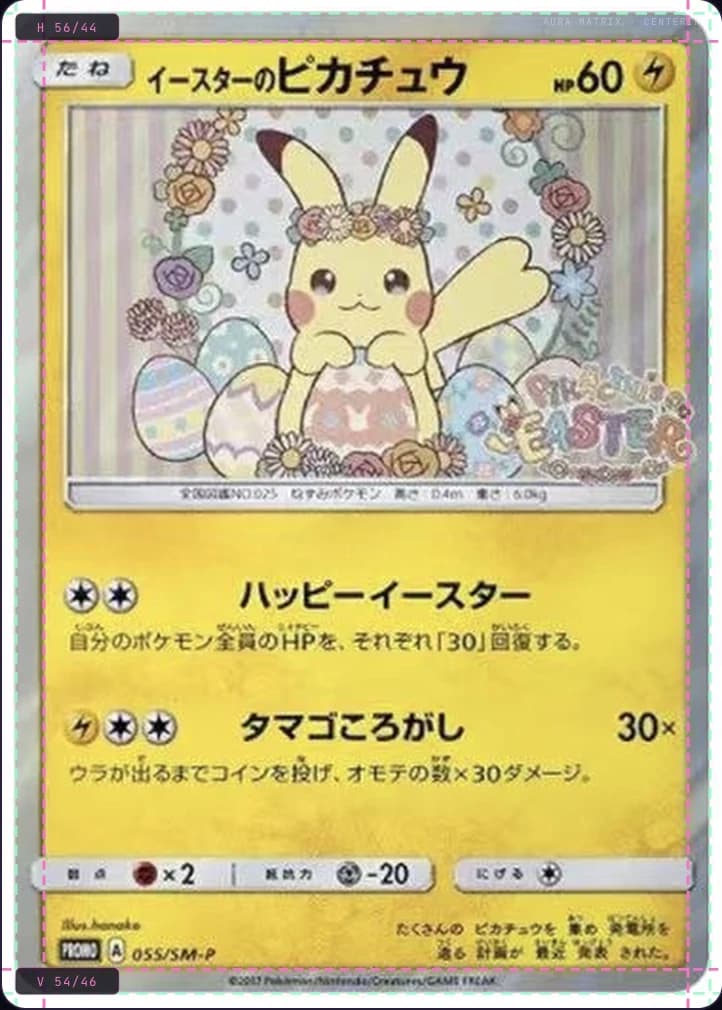
Easter Pikachu (イースターのピカチュウ, 055/SM-P) Japanese holo promo. Front centering drifts past the LAB dead zone (H 56/44, V 54/46 → 2× CTR-LAB minor); a ~2 mm hairline scratch on the upper holo field (SUR-1) and a sub-mm back-corner whitening (SUR-18, the PSA-10 blocker) account for the remaining deductions. Corners and edges read factory-fresh. Composite 94.0 → PSA 9 Mint.
CENTERING
Front centering measured pixel-precisely from the rectified capture: horizontal dominant ratio 56 / 44 and vertical 54 / 46. Both axes drift past the 50-51 measurement-noise dead zone into the minor band — each minor offset costs -5 on the centering axis (total -10, 100 → 90). The 56/44 reading does NOT reach the 60/40 boundary that would force a hard tier ceiling, so the impact stays on the axis score, not on the final tier. Back centering 51 / 49 H and 54 / 46 V sits inside the lenient back tolerance; the back contributes no deduction. No off-centre qualifier — that requires a 65/35 reading.
CORNERS
Front face — UL: tip sharp, no fiber whitening, no softness, no rounding past 0.2 mm. UR: factory-square apex, clean 90°, no ding or layer separation. LR: clean tip, no chip or fold. LL: no defects emit at this resolution. The yellow Pokemon border meets each front corner at a clean apex with no fiber lift visible against the halo strip. Back face — all four back corners (UL, UR, LR, LL) read clean at the captured resolution; the back-corner whitening detailed in the SURFACE section is scored under SUR-18 (back-print whitening), not under the corner axis, because the affected pixel cluster sits inside the back artwork field rather than at the apex itself. No COR-1 through COR-8 codes fire on either side. Per RED LINES §3 of the vision system prompt, fabricating low-confidence whitening to pad the ledger is explicitly forbidden — clean is clean. A flatbed scanner re-capture would surface sub-pixel features below this band's resolving power; that uncertainty is reflected in confidence_band, not in invented defects.
EDGES
Front face — Top → Right → Bottom → Left: all four front edges read factory-cut consistent. No EDG-1 whitening, no EDG-2 chips, no EDG-3 nicks, no EDG-4 fraying, no EDG-5 rough cut, no EDG-6 layer separation, no EDG-7 dents, no EDG-8 crease. EDG-10 (silvering on dark borders) is not applicable — the card uses a uniform yellow Pokemon border, not dark. Back face — all four back edges (Top, Right, Bottom, Left) likewise read factory-cut, with the standard Pokemon back-print colour running uninterrupted to each rectified edge. A faint warm-tone cast running along all four edges on both sides is uniform end-to-end; per CAPTURE-ARTIFACT §2 (white-balance cast on light borders) this is treated as WB cast, NOT localized edge whitening, and no defect emits. Yellow border thickness is consistent across the four front sides within sub-mm measurement noise. Edges read factory-fresh from this capture on both faces.
SURFACE
Front face — gloss reads uniform end-to-end with no dull patches or fingerprint haze. The holo layer shimmers evenly across all viewing angles; the only blemish is a ~2 mm hairline scratch at roughly the 2 o'clock position on the upper holo artwork field, visible only at oblique viewing, with no foil disruption beneath (SUR-1 minor, -6). Print register is on-spec — the four-colour rosettes align across the Easter foil emblem and the illustrator credit, no doubled outlines, no off-register text. Cardstock lies flat with no measurable warp. Back face — the standard Pokemon back-print is sharp with the Pokeball motif intact, but a sub-millimetre pinpoint fiber whitening sits at the upper-right back corner against the dark border (SUR-18 minor, -5). The two defects cost the surface axis 11 points combined (100 → 89). CRITICAL: SUR-18 back-print whitening is the industry-recognised 'PSA-10 blocker' — its presence forces the final tier ceiling to PSA 9 regardless of how clean the other axes read. Without this single sub-millimetre hit the card lands at PSA 10 Gem Mint; the back corner is the binding constraint, not centering and not the holo hairline.
PRINT QUALITY & FACTORY ARTIFACTS
No print lines, dot defects, ink-bleed, or registration shift detected. Cardstock uniform, no warp. HP/attack text sharp, illustrator credit (Illus. hanako) and 2017 copyright legible. The Easter foil emblem reads intact. The visible centering offset (left border ~0.6 mm thicker than right) is a factory print-shift artefact — the engine treats factory drift and card-doctor work identically when scoring centering offset.
COMPOSITE VERDICT
Per-axis: Centering 90 · Corners 100 · Edges 100 · Surface 89. Four-axis average: 94.75. The back-whitening hit triggers a tier cap that lowers this to 94.0, mapping to PSA 9 Mint. Without the back whitening, this card would land at PSA 10 Gem Mint (composite 96, capped by the weakest-axis rule). BGS Pristine is out of reach for three reasons: composite below the 98 floor, weakest axis below the 100 floor, AND back-whitening is on the Pristine blocklist. The corner-of-the-back whitening is the single decision-relevant defect — fix it and the card jumps a full tier.
CONFIDENCE BAND
Studio-quality capture passes all server-side QC gates (focus, exposure, tilt < 5°, glare < 10%). Net quality 0.96 places this in the HIGH confidence band — every defect callout above is at high confidence, and the tier prediction is stable under reasonable re-captures.
COMPARABLE REFERENCES
Defect-pattern projection only — not a population statistic. Cards with this profile (sub-mm front centering drift + holo hairline + back corner whitening) typically receive PSA 9 Mint at PSA, BGS 9 to 9.5 at Beckett, CGC 9 at CGC. The back whitening is the binding industry signal across all three graders; remove it and this card sits comfortably in PSA 10. Residual error band: ±0.5 tier at 12-18% confidence.
This predicted tier may carry a grading premium. If recent sales of this card clearly exceed the total grading cost (PSA fee + shipping), submitting is more likely to pay off.